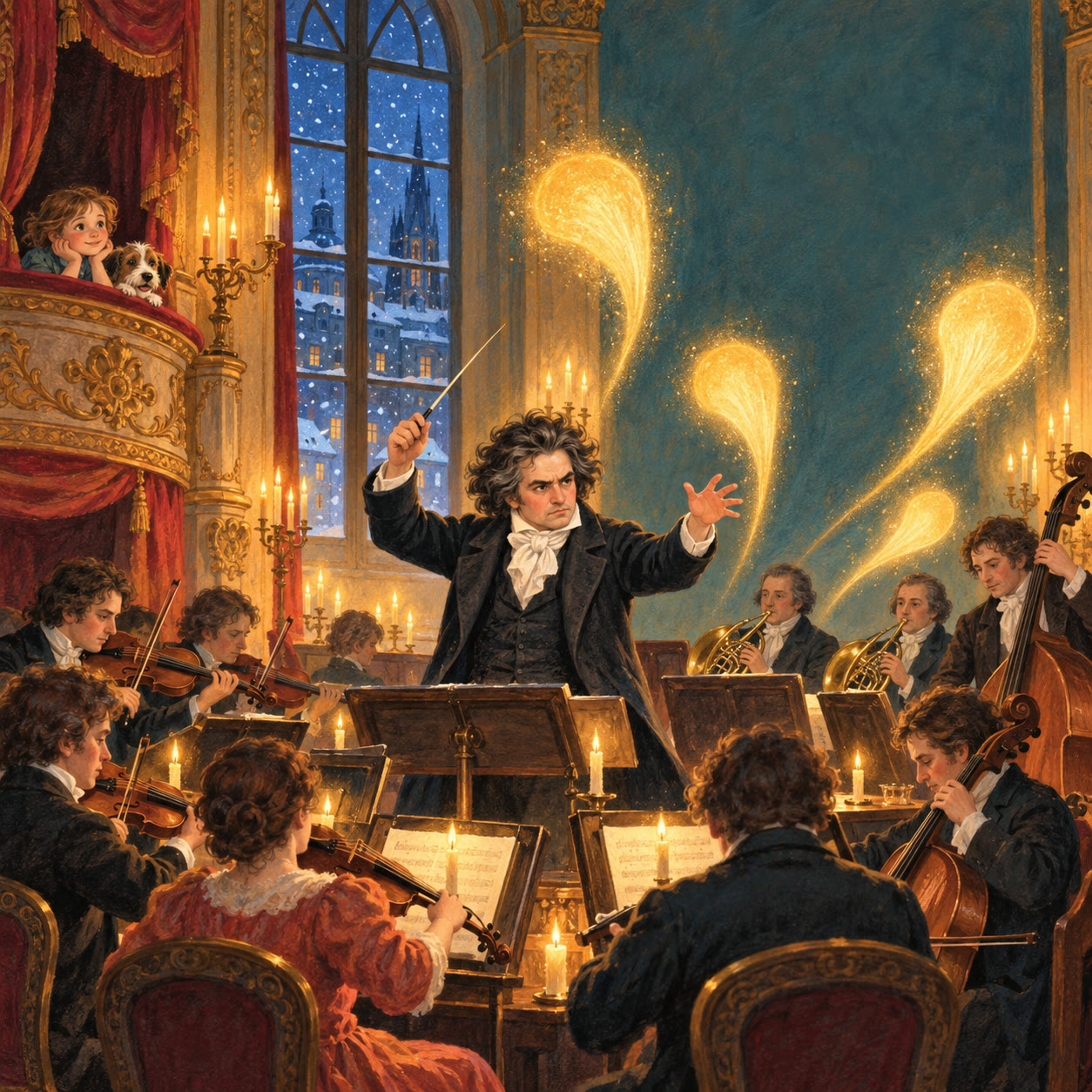
Four
knocks.
Ludwig van Beethoven
Short, short, short… long.
Can you knock it on the table?
Hear one of the most famous beginnings in all of music. Find out how four little notes grow into a whole storm, and then make some knocks of your own.

A tiny
idea.
Some of the biggest music starts very small.
In the autumn of 1803, a composer in Vienna had an idea. It was only four notes long: three short notes, then one long one.
His name was Ludwig van Beethoven. He came back to that little idea again and again. He changed it, moved it and passed it around, for more than four years. By the spring of 1808 it had grown into a whole symphony: music for a big orchestra.
Something hard was happening to Ludwig, too. His ears were getting weaker. He could still hear music, but not as well as before.
Ears that grew quiet
In 1801 Beethoven wrote to his old friend Franz Wegeler. For three years, he said, his hearing had been getting weaker and weaker.
The next autumn, in the village of Heiligenstadt, he wrote a private letter about how sad this made him. But he kept writing music.
When the Fifth Symphony was first played, Beethoven was hard of hearing, but not yet deaf. Years later, his friends had to write their side of a conversation in little notebooks so that he could read it.
A house on the old city wall
Vienna was once surrounded by a thick stone wall. While he was working on this symphony, Beethoven lived in a house on part of that old wall, called the Mölker Bastei.
There he worked on two symphonies side by side: the stormy Fifth and the Sixth, which is called the “Pastoral” Symphony. Today the house is a Beethoven museum.
Friends who helped
Composers needed people to help pay for their music. Beethoven dedicated this symphony to two music-loving noblemen who supported him: Prince Lobkowitz and Count Razumovsky.
A dedication is a little like writing a friend's name at the front of a book, to say thank you.
Listen for the knocks.
Short, short, short, long. Then again, a little lower. How many times can you hear them?
The real orchestra
A whole orchestra: strings, woodwinds, horns, trumpets and drums.
All starting from four notes.
Follow the knocks.
Hear the first five bars on piano: the high strings, the low strings, or both.
Choose a part and watch its notes move.
About this recording and arrangement
University of Colorado Boulder Symphony Orchestra, conducted by Gary Lewis. Recording © University of Colorado Boulder College of Music, licensed under Creative Commons Attribution 3.0 (CC BY 3.0), via Wikimedia Commons and YouTube. We play the first part of the movement (the exposition, bars 1–124); our copy is trimmed, made a little louder and faded at the ends. The piano example follows bars 1–5 from an early printed score (Breitkopf & Härtel, Leipzig, about 1826): the violins' line and the cellos' line, two octaves apart, with each held note lengthened a little. Piano samples: Salamander Grand Piano by Alexander Holm, CC BY 3.0. Orchestral sounds in the experiments: VS Chamber Orchestra 2 Community Edition by Versilian Studios (Sam Gossner) and Ivy Audio (Simon Dalzell), CC0.
What can four notes do?
Stretch them. Move them. Pass them on. Hide them. Guess first, then listen.
Your turn, composer.
Start with four knocks. Answer them a step lower. Then let them grow into your own storm.
Your tuneHigh and low
Add some low notesThe bass part
Your first bar is ready. Where will your knocks go?
Knock it again.
The knocks
travel on.
Beethoven's four notes did not stay in Vienna.
The symphony was first played on a freezing winter night in 1808. Since then, orchestras have played it again and again, like the university orchestra you heard on page three.
Once, those four notes even became a signal of hope, sent by radio across a whole continent.
The coldest concert
On 22 December 1808, Beethoven put on his own concert at the Theater an der Wien in Vienna. The programme was packed with his own music. The Fifth and Sixth Symphonies were heard for the very first time, on the same night.
Beethoven played his Fourth Piano Concerto himself and made up music on the piano on the spot. It was one of the last big concerts where he played the piano himself. The grand finale was another brand-new piece, his Choral Fantasy.
The theatre was icy. The composer Johann Friedrich Reichardt sat in the audience from half past six until half past ten. “There we sat, in the most bitter cold,” he wrote. Four hours! And the musicians had not practised enough. In the last piece they got muddled and had to start again from the beginning.
Fate at the door?
One famous story calls these four notes “fate knocking at the door”. Imagine a visitor with something important to say: knock, knock, knock… KNOCK!
The music has no words. You can give those knocks a story of your own. Who is at your door?
Three short, one long: V
In Morse code, letters are sent as short and long beeps. The letter V is dot, dot, dot, dash: short, short, short, long. Just like Beethoven's knocks.
During the Second World War, “V for Victory” became a sign of hope for people living under occupation in Europe. It was first heard on the BBC in January 1941. That year, the BBC began playing Beethoven's rhythm on the timpani before its news broadcasts to occupied Europe.