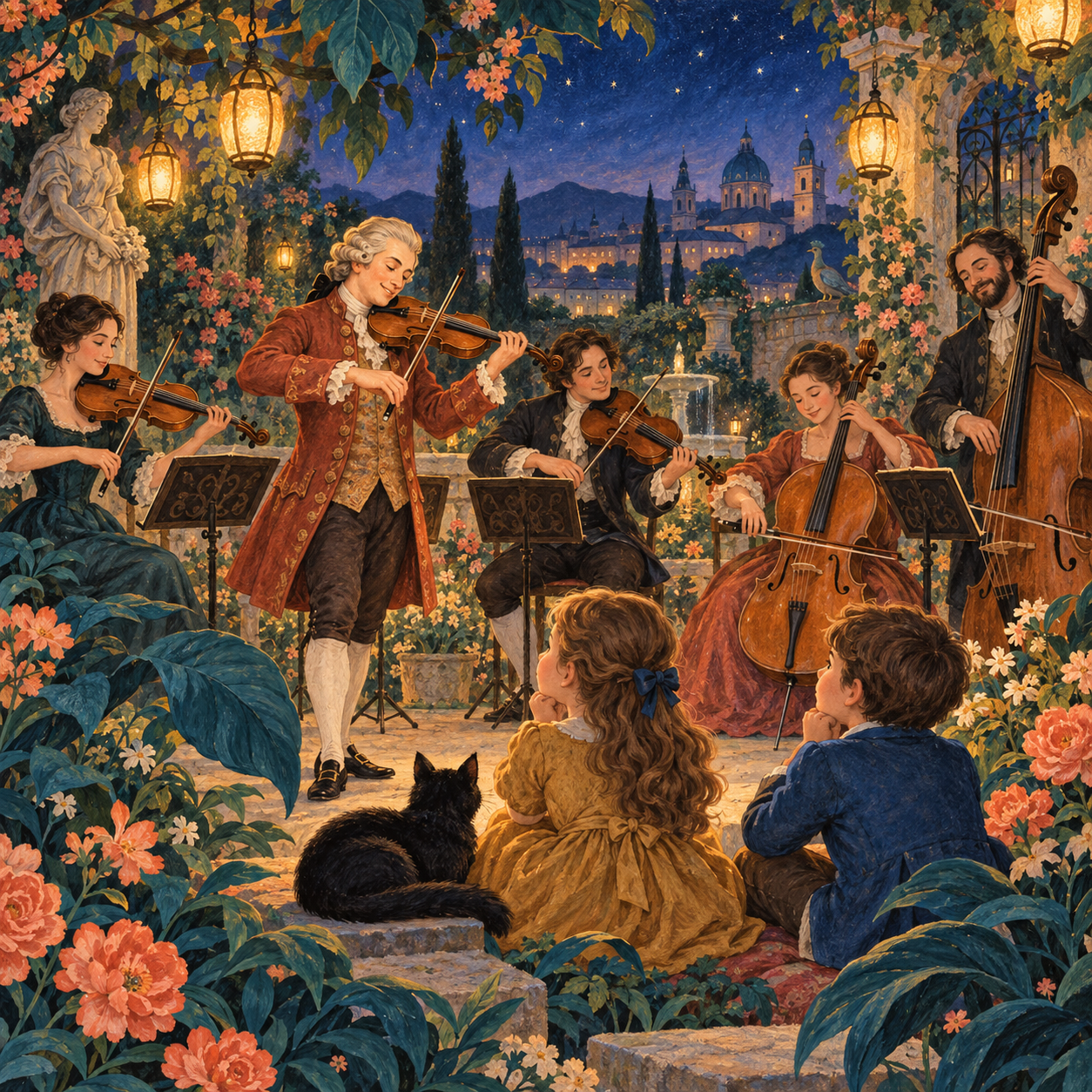
A little
night music.
Wolfgang Amadeus Mozart
The strings are ready.
The evening is yours.
Listen to a famous tune, discover its little surprises, and make some music of your own.
A boy at
the palace.
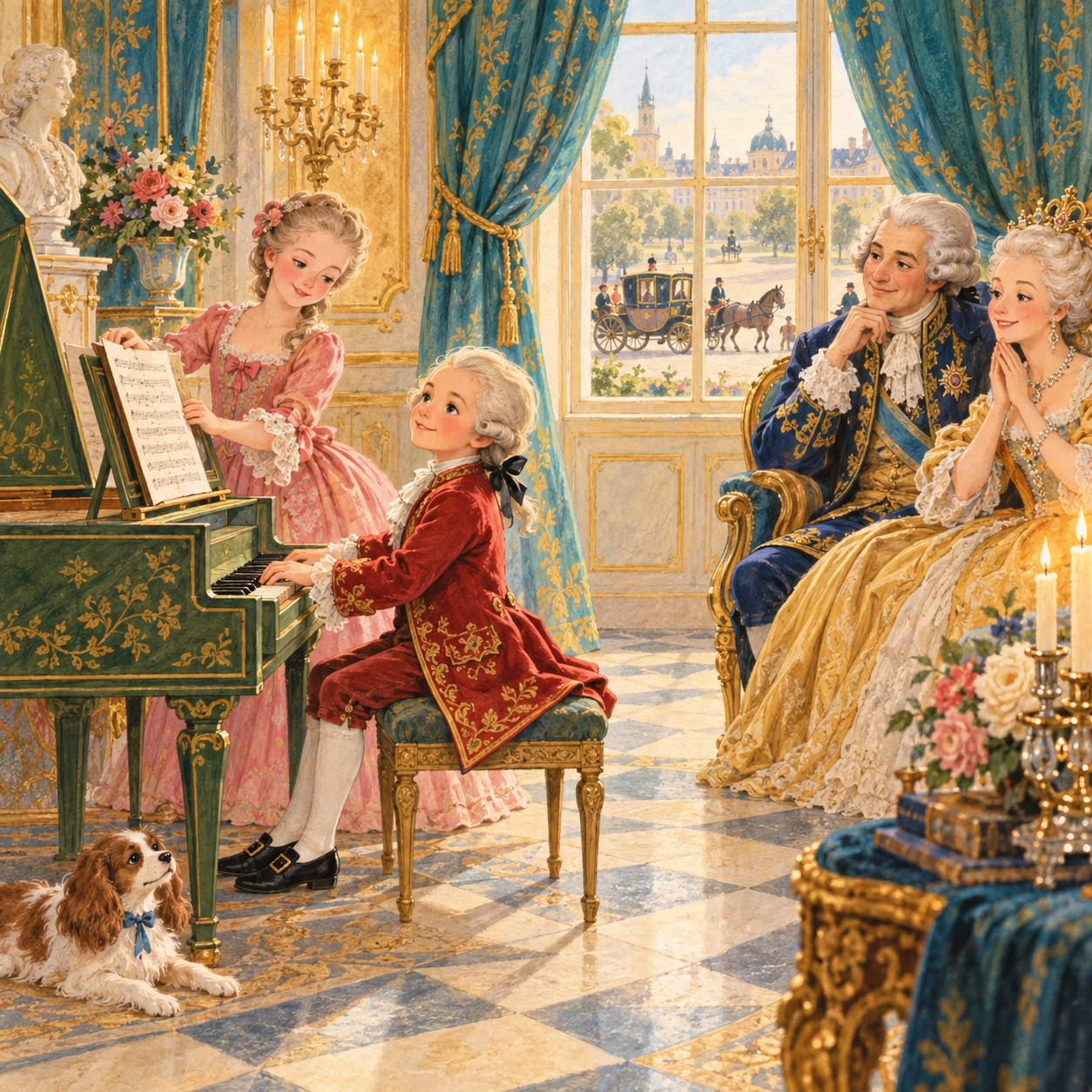
Imagine playing for a king when you are only eight.
Wolfgang Mozart did just that. He and his big sister Nannerl travelled across Europe with their family, playing music in grand rooms for people in silk coats, sweeping dresses and powdered wigs.
The children had something special to share. But first came the long journey, the waiting, and the practice.
Inside the palace
In London, Wolfgang played for King George III and Queen Charlotte. The queen played the harpsichord too: its keys make little quills pluck the strings inside.
Music was part of court life. Rulers and wealthy families invited musicians to perform, supported their work and asked them for new pieces. A beautiful room was also a place to earn a living.
A family on the road
Wolfgang's father, Leopold, was a musician and teacher. His mother travelled with them, and Nannerl was a gifted keyboard player. Their long tour took them to Paris, London, The Hague and many towns in between.
A coach was much slower than a car. There were bumpy roads, unfamiliar beds and months away from home. At each stop, the children met new people and heard new music.
From Wolfgang to Mozart
The little boy grew into a composer who could fill a theatre with music. Years later he settled in Vienna. He taught pupils, played concerts, and wrote pieces for people to perform.
In 1787, when Mozart was thirty-one, he wrote Eine kleine Nachtmusik: “a little night music.” Now it is our turn to listen.
Listen closely.
A bold hello from the strings. Can you hear the little spaces between the notes?
The real orchestra
Violins, viola, cello and double bass.
A whole family of strings.
Follow the tune.
Hear the opening on piano, one part at a time.
Choose a part and watch its notes move.
About this recording and arrangement
Sir Thomas Beecham conducting the London Philharmonic Orchestra, recorded in 1945. Transferred from 78 rpm records by Bob Varney; CC0 dedication via Internet Archive. The piano example follows the opening four bars, with the upper melody and the low string line. Piano samples: Salamander Grand Piano by Alexander Holm, CC BY 3.0.
A little musical magic.
One small change. A different sound. What will you discover?
Your turn, composer.
Give your tune a little jump, a little rest, and a place to come home.
Your tuneHigh and low
Add some low notesThe bass part
Your first bar is ready. Where will your tune go?
And played again.
The music
travels on.
Mozart's coaches stopped long ago. His music kept going.
Radio and records carried this little piece around the world. Today, a violinist lifts a bow, a child recognises the first notes, and the music begins again.
A working life in Vienna
Mozart made Vienna his home in 1781. He gave keyboard lessons, played in concerts and wrote music for singers and instrumentalists. He earned his living from pupils, audiences and people who paid for new music.
He wrote this serenade in 1787, the same year as his opera Don Giovanni. The opera needed singers, scenery and a theatre. This little night music needed strings.
Meet the string family
Two violin parts lead the way. The viola adds a lower, warmer voice. The cello and double bass give the music its low notes. All of them make sound with strings stretched across wooden bodies.
A bow draws out a long sound. A short stroke makes a crisp one. Listen again for the moment when all the players begin together.
More than an opening
Eine kleine Nachtmusik has four movements to hear today. A movement is a whole section of a larger piece, with its own pace and shape.
The lively Allegro comes first. A gentler Romanze follows, then a minuet and a quick final rondo. The tune on this page is only the beginning of the adventure.