The music
that goes round.
Johann Pachelbel
The low notes take eight steps.
Then they start again.
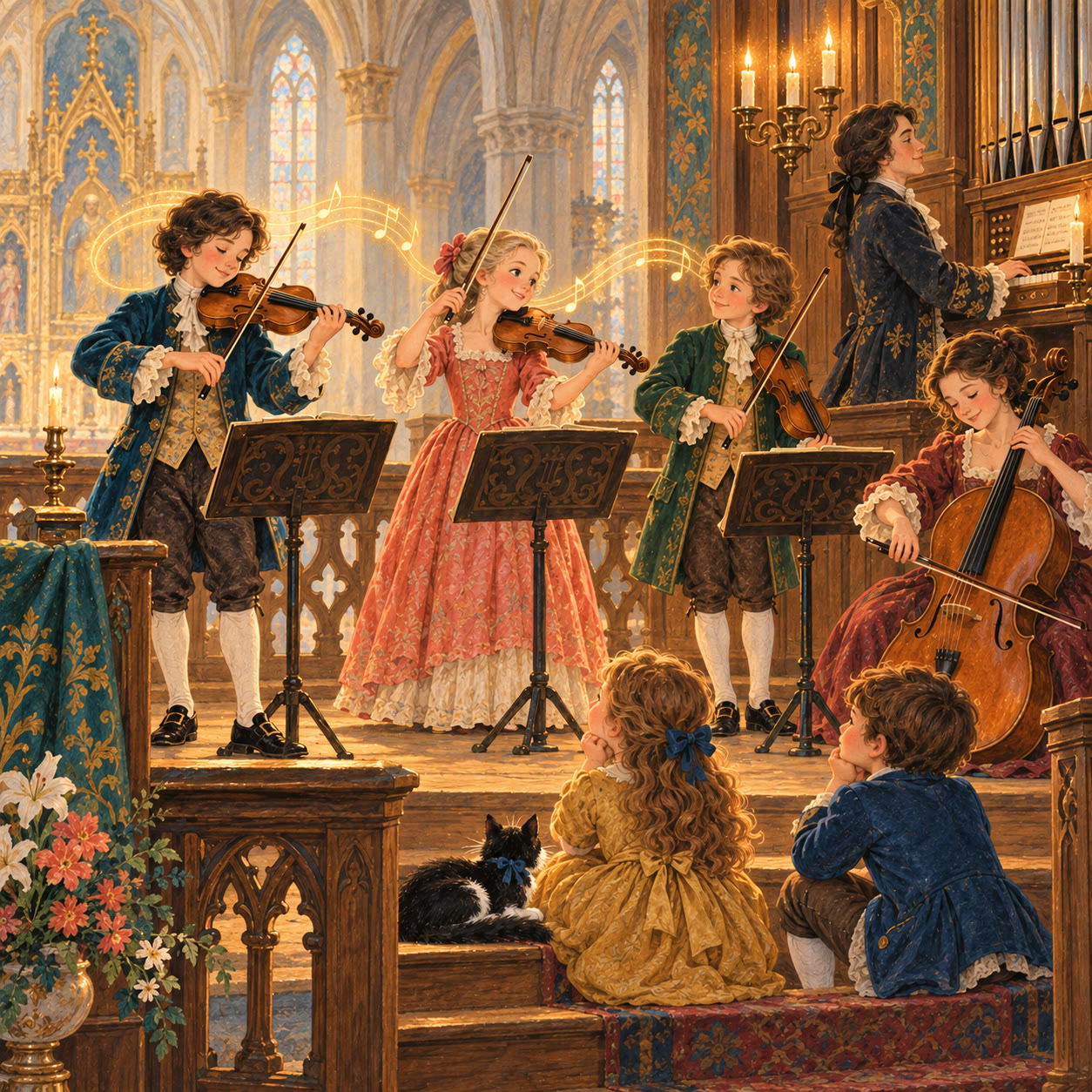
Walk with the bass, follow three violins playing one tune, and write your own tune over Pachelbel’s steps.
The organist
of Nuremberg.
Some instruments are so big, you play them with your hands and your feet.
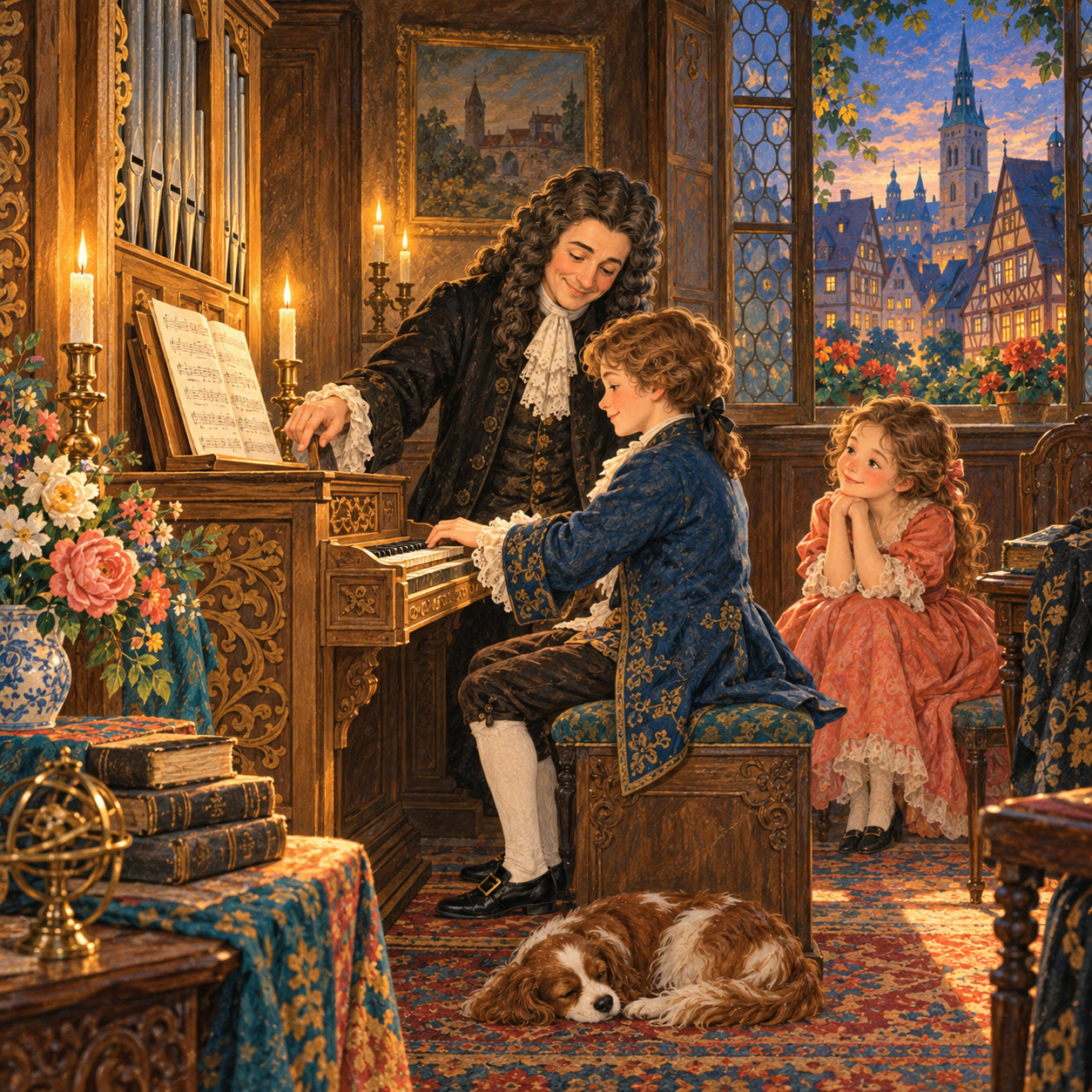
Johann Pachelbel was born in Nuremberg, in Germany, in 1653. He grew up to play the church organ, with its rows of shining pipes, and he became one of the best organ players of his time.
He wrote music, and he taught children how to play. One of his pupils had a little brother called Johann Sebastian Bach.
An organist in many towns
In 1678 Pachelbel became the organist of the Predigerkirche, a church in the city of Erfurt. Later he worked in Stuttgart and in Gotha.
In 1695 he came home to Nuremberg to play the organ at St. Sebaldus Church. He stayed there for the rest of his life, until he died in 1706.
Bach’s music grandfather
One of Pachelbel’s pupils was Johann Christoph Bach. When Johann Christoph grew up, he gave his little brother, Johann Sebastian, his first keyboard lessons.
So Pachelbel taught the teacher of one of the most famous composers ever. That makes him a kind of music grandfather to Bach.
Friends with the Bach family
Pachelbel was a close friend of Ambrosius Bach, Johann Sebastian’s father, who was a musician in the town of Eisenach.
He was even godfather to one of Ambrosius’s daughters, Johanna Juditha. Music ran all through that family, and Pachelbel was part of its story.
Listen closely.
First the low notes start walking. Then one violin begins a tune. Can you hear the next violin copy it?
The real orchestra
A string orchestra, with chords
playing underneath.
Follow the tune.
Hear the first violin’s tune and the walking bass on piano, one part at a time.
Choose a part and watch its notes move.
About this recording and arrangement
Johann Pachelbel, Canon in D (opening). Romanian Radio Chamber Orchestra, conducted by Tiberiu Soare; recorded live at Radio Hall, Bucharest, on 23 November 2011. Recording © Societatea Română de Radiodifuziune (Romanian Radio Archive DVD-FM-500), shared through Europeana and Culturalia under the Creative Commons Attribution-ShareAlike 4.0 licence. This excerpt is the first 36 bars, trimmed with a fade, and is shared under the same licence.
The piano and practice examples follow the Mutopia Project edition of the Canon per 3 Violini e Basso, typeset by Michael Fischer v. Mollard (CC BY 4.0): the first violin and the bass line, bars 3–6. Piano samples: Salamander Grand Piano by Alexander Holm, CC BY 3.0. Violin and cello samples: VS Chamber Orchestra Community Edition, CC0.
Round and round.
Change one thing. Listen again. Then find it in the orchestra.
Your turn, composer.
Pachelbel’s bass is already walking. Add a tune on top, step by step.
Your tuneHigh and low
The walking bassPachelbel’s eight steps
Pachelbel’s bass is walking. Where will your tune go?
Round and round again.
Lost
and found.
Nobody knows when Pachelbel wrote his Canon, or who it was for.
For a long, long time, hardly anyone played it. Then, hundreds of years later, people heard it again, and they could not stop listening.
Almost forgotten
No copy in Pachelbel’s own hand has survived. The oldest copy we have was written out by someone else in the 1800s, and it lives in a library in Berlin.
The Canon was first printed in 1919. Even then, only a few music experts knew about it.
Famous at last
In 1968, an orchestra led by Jean-François Paillard made a slow, dreamy recording of the Canon. People all over the world fell in love with it.
By the 1970s and 1980s it seemed to be everywhere.
Round and round, everywhere
Today the Canon is played at many weddings. Its eight chords turn up in lots of other songs too. Once you know them, you may start hearing them everywhere.
In the whole Canon, the bass walks its eight steps 28 times without changing, while the three violins keep finding new things to play on top.