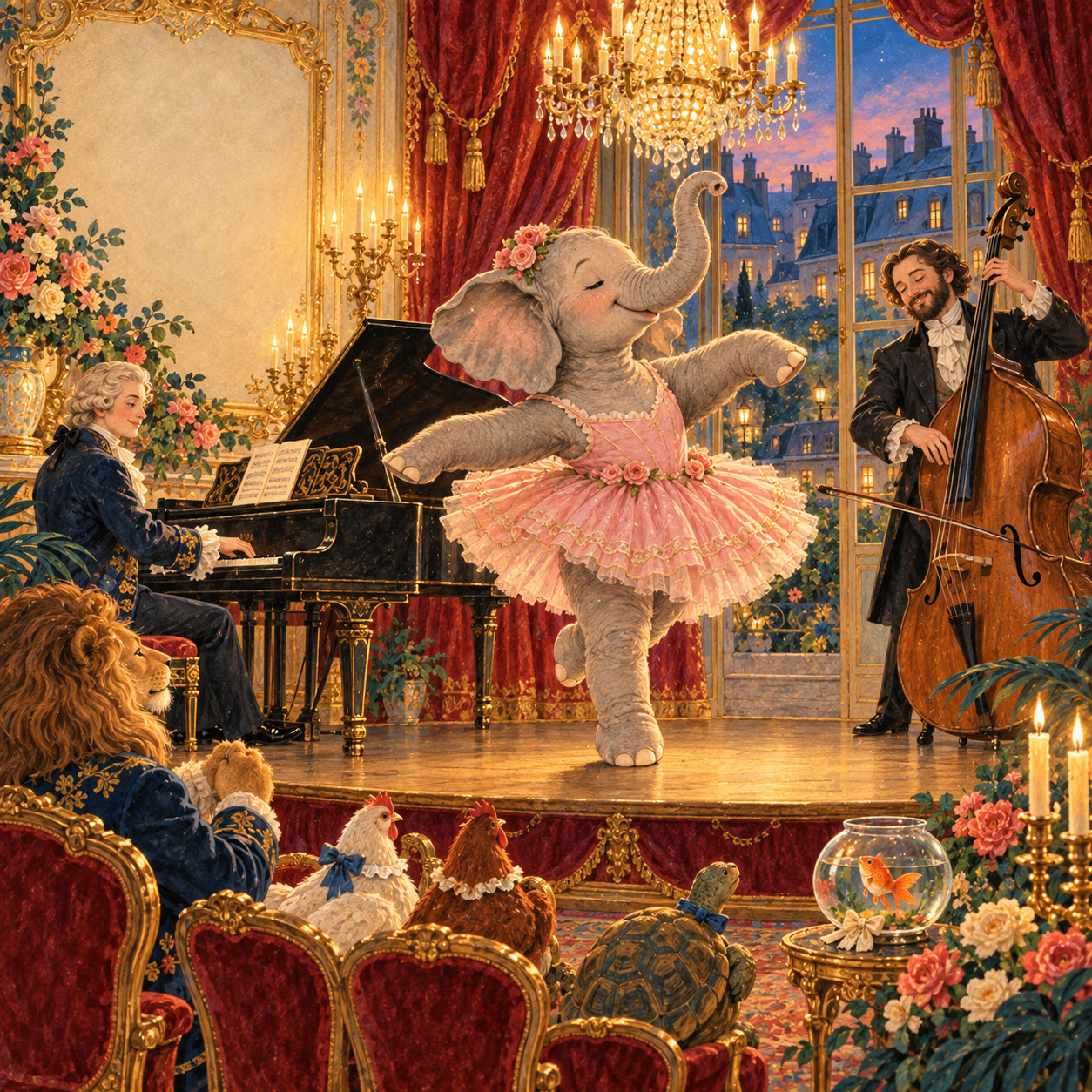
The elephant's
waltz.
Camille Saint-Saëns
The biggest dancer in the room
is also the lightest on its feet.
Listen to the double basses dance, find a tune borrowed from fairies, and write a waltz of your own.
A joke
for friends.
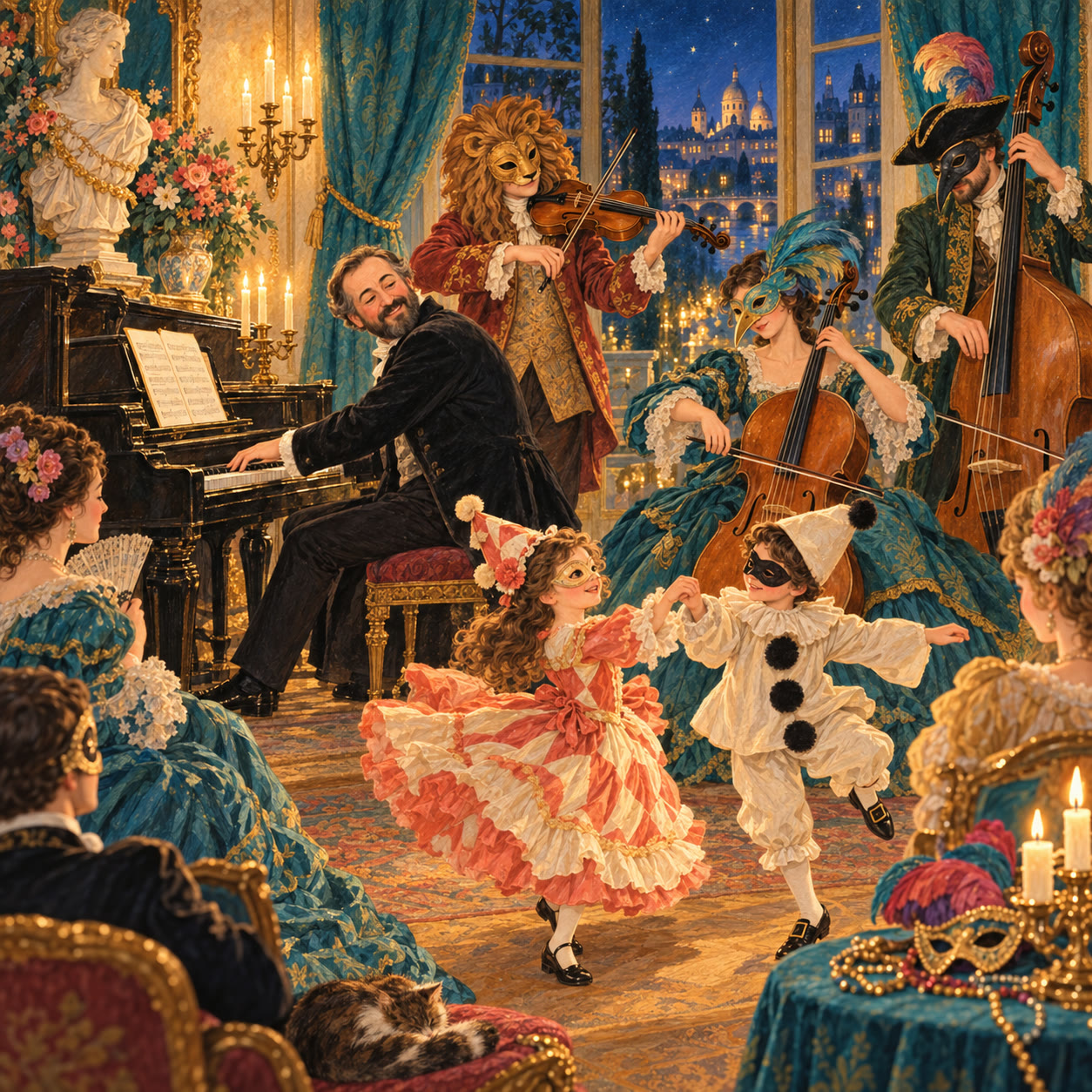
Imagine writing a whole piece of music just to make your friends laugh.
In February 1886, Camille Saint-Saëns was on holiday in a little village in Austria, near Vienna. There he wrote a funny piece full of animals: a lion, tortoises, kangaroos, fish in an aquarium, a swan, and an elephant.
He called it The Carnival of the Animals. On Carnival day in 1886, a day for dressing up and playing jokes, he and his friends played it at the home of the cellist Charles Lebouc in Paris.
A boy at the piano
Camille began playing very young. When he was six, he was already playing in the grand drawing rooms of Paris.
When he was ten, he gave his first big concert with an orchestra. He played piano music by Mozart and Beethoven, and he played it all from memory.
Just for friends
The Carnival was a musical joke. It was played for friends in small rooms, about fifteen times between 1886 and 1894.
Soon Saint-Saëns would not let anyone play it at all. He was famous for serious music, and he worried that his joke would stop people taking him seriously.
The best organist in the world
In 1857 Saint-Saëns became the organist of the church of La Madeleine in Paris. He played there for about twenty years.
The great pianist Franz Liszt called him the best organist in the world.
Listen closely.
First the piano says oom-pah-pah. Then the double basses, the biggest string instruments, start to dance. Can you count ONE-two-three?
The real musicians
A piano and the double basses
of a youth orchestra.
Follow the dance.
Hear the piano's oom-pah-pah and the elephant's tune on our piano, one at a time.
Choose a part and watch its notes move.
About this recording and arrangement
Camille Saint-Saëns, “L'Éléphant” from The Carnival of the Animals. Performed by Neal and Nancy O'Doan (pianos) and the Seattle Youth Symphony, conducted by Vilem Sokol (recorded around 1980; Pandora Records, Al Goldstein collection). Source: Wikimedia Commons. Licence: Creative Commons Attribution-ShareAlike 2.0. Converted to MP3; the converted file is shared under the same licence.
The piano example follows the first edition (Durand, Paris, 1922): the piano's introduction in bars 1–4 and the double-bass tune in bars 5–12, which the piano plays one octave higher than the basses sound. Piano samples: Salamander Grand Piano by Alexander Holm, CC BY 3.0. Double bass, cello, violin and flute samples: VS Chamber Orchestra Community Edition, CC0.
The big dance floor.
Change one thing. Listen again. Then find it in the real music.
Your turn, composer.
The low notes already go oom-pah-pah. Give your elephant a tune to waltz to: ONE-two-three.
Your tuneThree beats in every bar
Oom-pah-pahThe low notes
The oom-pah-pah is ready. Where will your elephant dance?
A light little tune.
The secret
gets out.
Saint-Saëns kept his animals a secret for the rest of his life.
He would not let anyone print the music, except for one piece, The Swan. After he died, the whole Carnival was printed at last, in 1922. Soon concert halls everywhere were full of lions, kangaroos, fish and elephants.
An elephant who dreams of fairies
In The Elephant, the double bass, the biggest and deepest string instrument, plays a dainty little waltz, as if the elephant thinks it is a ballet dancer.
In the middle, Saint-Saëns borrowed a tune from Hector Berlioz's Ballet of the Sylphs. A sylph is a fairy of the air. He even printed a little note about it at the bottom of the page, marked with a star.
Stars, plants and volcanoes
Saint-Saëns loved science as much as music. He studied the stars and planets and wrote a book about them. He was curious about plants, volcanoes and the new machines that could record sound.
In 1908 he wrote one of the very first pieces of music made for a film.
A traveller in disguise
He loved to travel to warm places, like Algeria, Egypt and the Canary Islands.
He was so famous that sometimes he travelled under a made-up name, Charles Sannois, so that people would leave him alone.